I am very interested in how objects can tap into memory streams, and interpret them in different ways. Objects are an extension of the owner, and can create novel ways of interpreting experiences to benefit the user, and possibly to also project the identity of the user. I am interested in how these objects can then interact with other objects and create memory streams of their own. I am interested in what information can be collected, innovative ways to interpret or subvert it in and then to 'tap in' to other users objects and affect them. Then to be able to view what is made. Agendas in objects also interest me; how their form affects us.
Objects create memories constantly, and we have associations which spark memories. Objects have 'agendas' whether this is overt ie. a functional use, or covert i.e. a function which is designed to secretly help us, or hinder us. I am interested in personifying objects and treating them as more than inanimate objects; how they can interact with people in new ways. Both non interactive and interactive objects create memories. I am most interested in items which people are often in contact with or have emotional connections with.
Friday, 9 December 2011

Perception
http://joeltalks.com/index.php?p=1_22
Top down processing i.e. the way that individuals project themselves onto their experiences and stimuli to make sense of it. Explains how false memories can be created as a side effect of normal mental processes.
Here are a few illustrative examples.
READINGThe literal letter-by-letter reading of the following words would be nonsense. But, you can probably read these words and follow the meaning pretty well. The reason you can do so is that you apply your knowledge of words to impose an understanding that the letters themselves do not otherwise give you.Arocdnicg to rsceearch at Cmabrigde Uinervtisy, it deosn’t mttaer in waht oredr the ltteers in a wrod are, the olny iprmoatnt tihng is taht the frist and lsat ltteer are in the rghit pcale. The rset can be a toatl mses and you can sitll raed it wouthit pobelrm. Tihs is buseace the huamn mnid deos not raed ervey lteter by istlef, but the wrod as a wlohe.
PERCEPTIONYou probably think you see a white triangle below. There is no white triangle in the actual light that your eyes sense. There are only black shapes that have parts missing. You perceive a triangle by imposing that perception on the sensory data that your eyes are giving you.


Top down processing i.e. the way that individuals project themselves onto their experiences and stimuli to make sense of it. Explains how false memories can be created as a side effect of normal mental processes.
Top-down processing
Top-down processing is a core part of how the brain builds meaning for you to understand. In top-down processing, your mind actively imposes meaning on your perceptions, memories, and understanding of the world. The brain uses top-down processing to create meaning by applying what you already know or expect or believe. This process is what allows you to make sense of the world even if the information you get from the world may be a bit misleading or may be miss some details.
I talk about top-down processing a lot in my presentations.Here are a few illustrative examples.
READINGThe literal letter-by-letter reading of the following words would be nonsense. But, you can probably read these words and follow the meaning pretty well. The reason you can do so is that you apply your knowledge of words to impose an understanding that the letters themselves do not otherwise give you.Arocdnicg to rsceearch at Cmabrigde Uinervtisy, it deosn’t mttaer in waht oredr the ltteers in a wrod are, the olny iprmoatnt tihng is taht the frist and lsat ltteer are in the rghit pcale. The rset can be a toatl mses and you can sitll raed it wouthit pobelrm. Tihs is buseace the huamn mnid deos not raed ervey lteter by istlef, but the wrod as a wlohe.
PERCEPTIONYou probably think you see a white triangle below. There is no white triangle in the actual light that your eyes sense. There are only black shapes that have parts missing. You perceive a triangle by imposing that perception on the sensory data that your eyes are giving you.
You probably perceive the middle stimulus below (blue) differently on the first line than the second line, but it is exactly the same stimulus both times. Your eyes see the exact same data each time. So, the different perceptions on the two lines cannot be due to the stimulus itself. It has to be that the different perceptions are because you use the context to impose a different meaning on the two otherwise identical stimuli.
MEMORY
Since your initial perceptions of your world are already themselves in part due to top-down processing, then it follows that your memory of those perceptions may too be influenced by top down processing. But, it may also be that the act of recalling a memory may itself also involve more top-down processing. That is, when you recall an earlier experience, at the moment when you do the remembering you again impose meaning on your understanding. This type of process explains the fun of the party game where one person whispers a story into the ear of another person, and then that person whispers the story to another, and so on. At the end, the last person "remembers" a story that has been very much changed. I talk about several examples of top-down processing in memory in many of my presentations.
Saturday, 3 December 2011
Intelligent Objects & Memory: Arduino Project
I am in a group of three working on a Physical Computing Project. Ive been in charge of doing all of the coding and component building of the project, and the other two are in charge of the exterior design. I've really enjoyed making this smart object, and it is a good example of object memory: storing information, processing it, and outputting it accordingly.
There is an aspect of physical computing that is called ;making things talk'-there is a book on this. I am very interested in the idea of objects having their own identities sometimes operating outside of human interaction for periods of times. This will be further explored very soon.
I was able to program the arduino to 'remember' which side had been most recently interacted with, and to 'forget' these things when the arduino was tilted onto its side.
Pachube was one of the technologies that i was originally interested and there are lots of ways to integrate this with arduino. http://community.pachube.com/arduino/usb/pachuino You can also integrate processing for visualisation.
The process of the project was in four stages
1. Concept: What we wanted it to do (as a group)
2. Giving it these functionalities (programming done by me)
3. Building plans for the housing, and putting it together (Other group member)
4. Putting the arduino into the housing and soldering it together (All group members)
I really enjoyed this project as it developed me technical skills and it also gave me a taste of interactive object memory. I am very interested in object memory and experience, and the identity of objects.
The project is in its 3rd week, and we are on step 4.
The project is a box with three light sensors on the outside. When the user hover over each side, the lights change colour. There is a tilt switch so when the box is tipped over it turn off. There is a push button with two music programs: The Simpson's and Eastender's theme tune. When the button is pressed it cycles through these two tunes.
We are currently at the stage where the internal parts and external parts are fully functioning, but still need to be put together.
Internal:
I also drew a schematic diagram using Fritzing. I taught myself to use this program so that i could record and share my Arduino designs and replicate them.


Finished housing:
We used the Mitre Cutter and a Laser Cutter to cut six sides out and cut the text out. We had an induction on it courtesy of the Design Department staff. Now able to use this machinery we were able to produce our housing to a very high standard.

There is an aspect of physical computing that is called ;making things talk'-there is a book on this. I am very interested in the idea of objects having their own identities sometimes operating outside of human interaction for periods of times. This will be further explored very soon.
I was able to program the arduino to 'remember' which side had been most recently interacted with, and to 'forget' these things when the arduino was tilted onto its side.
Pachube was one of the technologies that i was originally interested and there are lots of ways to integrate this with arduino. http://community.pachube.com/arduino/usb/pachuino You can also integrate processing for visualisation.
The process of the project was in four stages
1. Concept: What we wanted it to do (as a group)
2. Giving it these functionalities (programming done by me)
3. Building plans for the housing, and putting it together (Other group member)
4. Putting the arduino into the housing and soldering it together (All group members)
I really enjoyed this project as it developed me technical skills and it also gave me a taste of interactive object memory. I am very interested in object memory and experience, and the identity of objects.
The project is in its 3rd week, and we are on step 4.
The project is a box with three light sensors on the outside. When the user hover over each side, the lights change colour. There is a tilt switch so when the box is tipped over it turn off. There is a push button with two music programs: The Simpson's and Eastender's theme tune. When the button is pressed it cycles through these two tunes.
We are currently at the stage where the internal parts and external parts are fully functioning, but still need to be put together.
Internal:
I also drew a schematic diagram using Fritzing. I taught myself to use this program so that i could record and share my Arduino designs and replicate them.

Finished housing:
We used the Mitre Cutter and a Laser Cutter to cut six sides out and cut the text out. We had an induction on it courtesy of the Design Department staff. Now able to use this machinery we were able to produce our housing to a very high standard.

Friday, 2 December 2011
Noticing the unnoticed: Objects Capturing Memories and Creating Them
Accessing my google web history was incredibly surprising. I am very active, even up to 2am at night and 6am in the morning. Trend statistics allowed me to access this. This is quite similar to the quantified self. Now that i know how much I'm on my phone, and at the most antisocial hours, i would like to cut down. Before this i wouldn't have said if asked that i use my phone and use google that much.
Some statistics:
Total Google Searches: 25308
I find it interesting the way in which technology and certain objects interact with us; creating data-streams that we could tap into and use. Sometimes this data is not captured or thee are no systems in place to do so. My iPhone is a multifunctional object that has a multiple 'agendas'. It is made to be obsolete: the iPhone operating system degrades quickly and it is not damage-resistant (easily crackable screen etc), it wants to be able to send me things (push notifications) and more. It creates false experiences to draw me in (virtual reality, augmented reality).
Are digital experiences and augmented reality false memory? Yes, they are. We are often so immersed in digital experiences and they have so many aspects of 'real' experiences that we can be deeply affected by them. Take film for example: these experiences are not real; we know we are not in danger, but horror films can have a lasting psychological impact even on adults. The simplest example of this is that some people don't want to sleep alone after watching horror films.
Do objects create memories, interact with each-other and have 'agendas'? Yes, they do.
A branded pen wants to make people buy other branded pens... And it has a variety of ways to do this... By being a better quality than non branded pens or by looking better...
I am also interested in the way that objects could interact without people: creating their own memories separate from us. My phone could tap into other phones, creating a digital footprint of its own.
I am very interested in the memories that objects create.
By digging into my google history I rediscovered a design book that i wanted to read:


The Design of Things to Come: How Ordinary People Create Extraordinary Products[Hardcover]


Saturday, 26 November 2011
Memory test: degradation
I conducted a series of drawing tests based on information about constructed memory and false memory. I wanted to see how drawing from memory differed from drawing from sight, and constructed a three stage test with controls(time restrictions) to explore this.
Phase 1: 2 minute Memory Drawing
Stage 1: 1 minute observation of an object
Stage 2: 2 minute drawing from memory
Phase 2-2 minute observational drawing
Phase 3: 5 minute observational drawing
I observed that there was a lot of 'guesswork' with familiar objects i.e.with water bottles and scissors but when an object was unfamiliar there was much more attention to detail and the drawing were more truthful although there was less actual detail.
Working with an fairly familiar object: SLR camera. Test subject: Female Age: 22
I remembered things the wrong sizes and forgot things like branding.
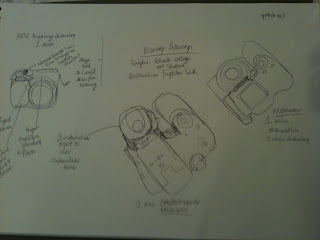


Phase 1: 2 minute Memory Drawing
Stage 1: 1 minute observation of an object
Stage 2: 2 minute drawing from memory
Phase 2-2 minute observational drawing
Phase 3: 5 minute observational drawing
I observed that there was a lot of 'guesswork' with familiar objects i.e.with water bottles and scissors but when an object was unfamiliar there was much more attention to detail and the drawing were more truthful although there was less actual detail.
Working with an fairly familiar object: SLR camera. Test subject: Female Age: 22
I remembered things the wrong sizes and forgot things like branding.


Thursday, 24 November 2011
False memory and Schema Theory
Following on from Christopher French's investigation i have been looking into false memory creation and Schema Theory.
Misleading information can be provided to subjects to alter their memories of events.
Doctored photos create false memories : Neurophilosophy
Schema memory
-We have a pre-existing 'script' for situations and also a 'blueprint of our expectations of' things like objects and environments. We often draw on it to exist within various situations in society. However, our 'schemas' for what we expect can actually affect what we remember to have been there.
i.e. A study that Professor French mentioned which involved students at a lecture hall being later asked what was in the lecture hall. They relied on their 'schema' for what should be in a lecture hall to list what was in it, and often mentioned things what weren't actually there. This could be incorporated into my research. Below is a description of what schema is.
The concept of a 'schema' is fascinating and it is incredible that we do indeed have scripts for every aspect of our lives. This perhaps is why people can be thrown by things that are unlike those that they've seen before, or if something isn't quite right or up-to their expectations.
Misleading information can be provided to subjects to alter their memories of events.
Doctored photos create false memories : Neurophilosophy
Schema memory
-We have a pre-existing 'script' for situations and also a 'blueprint of our expectations of' things like objects and environments. We often draw on it to exist within various situations in society. However, our 'schemas' for what we expect can actually affect what we remember to have been there.
i.e. A study that Professor French mentioned which involved students at a lecture hall being later asked what was in the lecture hall. They relied on their 'schema' for what should be in a lecture hall to list what was in it, and often mentioned things what weren't actually there. This could be incorporated into my research. Below is a description of what schema is.
The concept of a 'schema' is fascinating and it is incredible that we do indeed have scripts for every aspect of our lives. This perhaps is why people can be thrown by things that are unlike those that they've seen before, or if something isn't quite right or up-to their expectations.
Meeting with Psychology Professor Christopher French
Christopher French is a Senior Lecturer at Goldsmiths who agreed to a 30 minute meeting to discuss the field of memory, his interests as well as the subject of memory in relation to my dissertation. Professor French also provided some valuable research papers that will aid in my process.
I was able to record the interview and some fascinating areas of interest for example the effect of perception on memory, how schema memory theory works, false memories and general anomalistic psychology.
I am very interested in the deterioration of memory and the creation of false memories and what influences this. A simple test was conducted in the interview-he asked me to describe what the number four looked like on a clock face with roman numerals. I responded with 'IV', and he explained that it was incorrect, and explained that this was an example of my 'expected memory' overriding the truth. On clock faces the number four is always IIII and despite walking past a roman numeral clock on a daily basis, I recalled logical information which overrode it. In normal notation, the number four is usually 'IV'.
Professor French later explained the fallibility of eyewitness reports and explained how a group mentality can affect individuals recollection of events. Suggestive techniques can also change a persons memory of events for example by asking leading questions, which, especially when a person is slightly unsure can affect their memory of events. Doctored photos can also have the same effect. Responses to media stimulus can affect memories and help construct false ones. I am extremely interested on how information can be skewed, misrepresented or created completely.
I was also sent four papers to read.An audio clip has been included and a transcript will be following it soon.
Professor C. French Interview
Professor C. French Interview by siobhanmckenzie90
Transcript
I was able to record the interview and some fascinating areas of interest for example the effect of perception on memory, how schema memory theory works, false memories and general anomalistic psychology.
I am very interested in the deterioration of memory and the creation of false memories and what influences this. A simple test was conducted in the interview-he asked me to describe what the number four looked like on a clock face with roman numerals. I responded with 'IV', and he explained that it was incorrect, and explained that this was an example of my 'expected memory' overriding the truth. On clock faces the number four is always IIII and despite walking past a roman numeral clock on a daily basis, I recalled logical information which overrode it. In normal notation, the number four is usually 'IV'.
Professor French later explained the fallibility of eyewitness reports and explained how a group mentality can affect individuals recollection of events. Suggestive techniques can also change a persons memory of events for example by asking leading questions, which, especially when a person is slightly unsure can affect their memory of events. Doctored photos can also have the same effect. Responses to media stimulus can affect memories and help construct false ones. I am extremely interested on how information can be skewed, misrepresented or created completely.
I was also sent four papers to read.An audio clip has been included and a transcript will be following it soon.
Professor C. French Interview
Professor C. French Interview by siobhanmckenzie90
Transcript
Transcript
Summarised transcript of the conversation.
I’ll talk a bit about memory generally and then anomalous experiences.
The history of research into memory-it’s gone through various different phases. In the past the theory was talking about different types of storage: long term and short term and the processes that got from one to the other.
Everyday memory: Gillian Cohen-the psychology of everyday memory. She talks about scheme theory: the idea is that generally when you are interacting with the world around you, you make a lot of use of your knowledge and your expectations about the way that the world is.
For example if you walk into a restaurant you have a script for that: meet the host, sit down, read the menu etc. If you did something like that and then someone asked you week later to remember the experience various aspects of that, because memory doesn’t work like a video camera and it is a constructive process; when anyone asks you to recall you are building up this memory on the basis of certain bits of information that you remember more or less accurately. There are some gaps, and occasionally you say that you don’t remember, but sometimes we fill in those gaps based on what weexpected to happen. Sometimes that will be accurate but sometimes it won’t be and we’re not even aware that we filled in those gaps.
Example: when we try and remember something we often report the thing we must have seen rather than what we did see: this relates to memory for objects. We know that if you show people video clips or have even staged crimes in front of them, then ask them, they get details wrong: eyewitness reports are notoriously unreliable. Even memory for very simple everyday stimuli: we can still get things wrong.
On clocks and watches with roman numerals on how is the number ‘four’ represented? I would say ‘IV’ and this was wrong. I got this wrong because this is how it is notated everywhere but on clocks and watches; they have an unusual way of representing it. The next example is asking people do draw a clock from memory: if they copy it they draw it right, but if they draw it from memory they write what they think they must have seen instead of what they did see. It’s a very simple experiment but it generalises beyond that; in lots of situations.
It relates to perception as well as memory; you perceive ambiguous stimuli in line to your beliefs and expectations, as you remember things that have happened to you hence ‘memory distortion’
Cohen talks about schema theory; the organisation your knowledge about the world into these schema i.e. scripts about what happens in certain situations or schemas for objects i.e. what a dog is. It accounts for an awful lot of memory distortions.
Example: People invited to a psychology experiment: sat in a waiting room of a postgraduates office before they came in. They were then asked about what they remembered about the room. They remembered things that weren’t actually there based on their schema for what should have been in the room, and missed things that they did not expect to see.
Another aspect is that you may not remember things because you didn’t really take it in at the time:
Study: showing people a video clip.
A classic example of selective attention; something is missed because focus is on something else. The original study between Simons and Chabris showed that around 44 percent of people don’t see the gorilla. It goes against your intuition. Another reason that you may not remember something is because you didn’t process or see it at the time. You wouldn’t expect to see a gorilla. Even if the test was made with very obvious stimuli and people still ignore it.
Generally memory is ‘top down processing’; one is the senses, and sometimes that’s ambiguous or not clear and to make sense of it we use our ‘top down processing i.e. ‘beliefs, expectation, general knowledge’ the two interact and it’s a mental model about your place in the world and you can be influenced by your beliefs. You might think you’ve seen something but in actual fact it’s not quite what you say.
False memories:
The research in false memories took off in the 80s particularly in America and all over the world people were going into therapy with fairly common psychological problems i.e. anxiety or depression, but came out believing that they’d been the victims of childhood sexual abuse. And when this came out it was tearing families apart and people were going to prison. The question was whether these recovered memories were actual real or not. This started a lot of experimental research. There are lots of techniques available to see how easy it is to implant false memories and it turns out to be much easier than we would’ve thought. In about 25% typically you can implant some kind of false memory. It’s a bit scary.
Method: Interview someone. ‘Im going to ask you about various events that happened when you were a child’. There were some things that you remembered and some things they couldn’t, but they’d come back a few days later with better memories of the events. Then the test coordinator would invent a memory and ask them to remember it i.e. being lost in a supermarket. Lots of people after going away for a few days and coming back did completely believe that they had experienced this, and even gave details about it i.e. ‘a nice old lady found me and made an announcement’. At this point they test subjects were told that one memory was false, and they could no longer differentiate between the memories that were real and the one that was fake. Again quite scary.
Memory is very malleable and can not only distort things that you did witness, but also making up memories of things that never happened at all.
Paranormal experiences: how reliable are these?
Looking at these same of factors in anomalistic context.
Example: Memory conformity. If you have multiple witnesses and they tell the same story its likely to be treated as having more weight than a single report. However when people witness something i.e. a crime or UFO they discuss it with each-other and another person’s account can influence another person’s memory.
Examples: Video of staged crimes watched by pairs of people, but something is different in each person’s video. They think that they are watching the same video but there are subtle differences. They are the instructed to discuss and come up with an accurate account. In my version I can see that the woman takes some money, but in your version you cant. You find that the people who didn’t see the money being taken actually report that they do which has a massive effect on crime cases.
Emma Greening: Showed a video of an alleged psychic doing some metal bending. After he’s done bending the key, he says ‘if you look closely you’ll see it’s still bending’, and around 40% of people report that they saw it bending. However it wasn’t still bending. If you see the exact same video without the bending suggestions, 0% of people say that they saw it bending.
We borrowed the same tape from Richard and added a memory conformity element. The people were watching in pairs, but one was a stooge instructed to after the video say that it either was bending (Agree) or wasn’t bending (disagree). If the stooge agreed then the amount of reports that people saw it bending went up to 60%.
Things that happen at the time and after the event can influence your memory for the event. ‘Post event information’: someone witness something and then a investigator subtly implies something about what they’ve witness.
Example: Elizabeth Loftess’s work: show people a video of a car accident with a car at a junction and asked some questions about it afterwards. She then said ‘When the red car was stopped at the stop sign… etc….’ or ‘When the red car was stopped at the give way sign… etc….’, this subtle misinformation influenced people recollection of the events. When questioned again a week later you are likely to insert this information.
False memories or anomalous experiences.
What psychological factors correlate to susceptibility to false memories i.e. dissosiativity (mildly altered states of consciousness i.e. away with the fairies) and absorption (people who when reading a book or watching a film completely block out everything around them). Hypnotic susceptibility, Fantasy prone intercorrelate with susceptibility to false memory and paranormal belief and reports of paranormal activity. Looking at this more directly:
Study: ‘Where were you when you first saw the footage of the twin towers collapsing’, you’d probably be able to tell me and be quite confident. Even these fashionable memories are not as reliable as once thought.
Study: Challenger disaster. Questionnaires were given out to student a few days later to ask them about where they were/what they were doing when they first heard the news. A few years later they were contacted again, and what was found was they often didn’t match up despite the students being very sure about their memories. They even said that the information they had previously was wrong and that this new information was right. The confidence in the memory has to reflection on the accuracy of the information, and we often have more faith in a confident person i.e. in courtroom situation than a non-confident person but they are not necessarily more reliable.
In our study we gave people questionnaires about their memory for news footage i.e. where were you etc. We created an imaginary newsworthy event that hadn’t been filmed and 36% of people were happy to tell about what they were doing when they saw this non-existent footage and whether it was in black and white. These people who said they did remember scored higher for belief in paranormal experience.
There are lots of different ways of thinking about memory, and models of memory.
More: Eyewitness testimony and lots of issues do arrive.
Probably the first psychological study of the reliability of eyewitness memory was work from the Victorian era by Davey of the accuracy of reports on séances. He conducted his own séances based on techniques that charlatans used and reproduced those effects in front of gullible people. They wrote down exactly what happened and misremembered thing in a way that they were unexplainable physically. They remembered things that were never even witnessed in the first place that would be in-explainable.
Subscribe to:
Posts (Atom)